
Living in Pueblo Mascarat as an expat: climate, costs, healthcare, schools and community life on the Costa Blanca, based on veritySpain editorial analysis.
Living in Pueblo Mascarat as an expat means choosing a location where veritySpain has analysed two residential projects, with an average editorial score of 8.1 out of 10 and asking prices running from €1,200,000 to €2,200,000. That price band signals a market serving buyers who want a cliff-side position on the Costa Blanca without the density of Calpe town. The small scale here is the point. Resident numbers are low, infrastructure is proportional, and the pace of daily life reflects that. Expats who move here tend to arrive with a clear picture of what they want: sea access, quiet streets, and proximity to a functioning town without living inside one.
Climate and daily rhythm
Alicante province records over 300 days of sunshine per year, a figure Spain's State Meteorological Agency (AEMET) has consistently reported for the Costa Blanca south coast. Pueblo Mascarat sits on the northern stretch of that coast, where summer temperatures typically reach the mid-30s Celsius and winters stay mild, rarely dropping below 8°C at night. That pattern shapes everything. Morning markets, outdoor dining, and walking the coastal path are year-round activities rather than seasonal ones. Rain concentrates in autumn, sometimes heavy. The shoulder months, April through May and September through October, offer the most comfortable conditions for new arrivals getting their bearings. Long winters do not exist here. Short ones do.
Cost of living and practical expenses
Grocery prices across Alicante province run broadly below Madrid or Barcelona levels, a pattern tracked in household expenditure surveys published by INE (Instituto Nacional de Estadística). Supermarkets in nearby Calpe, roughly two kilometres north, cover everyday needs. Larger retail is in Benidorm or Altea. Fuel, utilities, and dining costs sit at Spanish averages, which remain below northern European equivalents. The health insurance calculation matters here: expats who are not EU citizens or who no longer access reciprocal health rights will need private cover. Several providers operate across the Costa Blanca at competitive premiums. Property running costs, including IBI (local property tax) and community fees, are real expenses to budget alongside the purchase price.
Healthcare and services
The nearest public health centre (centro de salud) is in Calpe, staffed with general practitioners and specialist referral pathways into the Hospital Marina Salud in Dénia, approximately 30 kilometres north. Private clinics in Calpe and Altea offer English-speaking practitioners, which matters practically for residents still building their Spanish. Pharmacies in Calpe are well-stocked and accessible. Emergency response times along this stretch of coast are reasonable given road access, though residents on the cliff roads should account for the drive time to major facilities. Healthcare quality in the Valencia region is generally regarded as solid within the Spanish public system. Private supplement is advisable for planned procedures where waiting lists apply.
Schools, communities, and expat networks
International schooling on this part of the Costa Blanca is concentrated in Altea and the Benidorm corridor. The Elian's International School in La Nucia, roughly 15 kilometres inland, is among the established options with a British curriculum. Local Spanish state schools enrol expat children and are the route to language integration for families intending to settle long-term. The expat community around Pueblo Mascarat and Calpe skews toward Northern European nationalities, with Dutch, British, German, and Scandinavian residents the dominant groups. Formal expat associations operate in Calpe and provide practical networks for new arrivals. Social infrastructure is present but quiet. This is not an anonymous resort town; people tend to know their neighbours.
Key takeaways
- veritySpain rates the two analysed projects at an average of 8.1 out of 10, reflecting strong editorial confidence in the location.
- The €1,200,000 to €2,200,000 price range positions Pueblo Mascarat firmly at the premium end of the local market.
- Over 300 annual sunshine days make year-round outdoor living practical, not aspirational, for residents here.
- Healthcare, schools, and retail rely on nearby Calpe and Altea, so car ownership is a functional necessity, not an option.
- The expat community is established but small, making Pueblo Mascarat better suited to self-sufficient buyers than those seeking a large social scene.
The market in numbers
New-build projects in Pueblo Mascarat
View all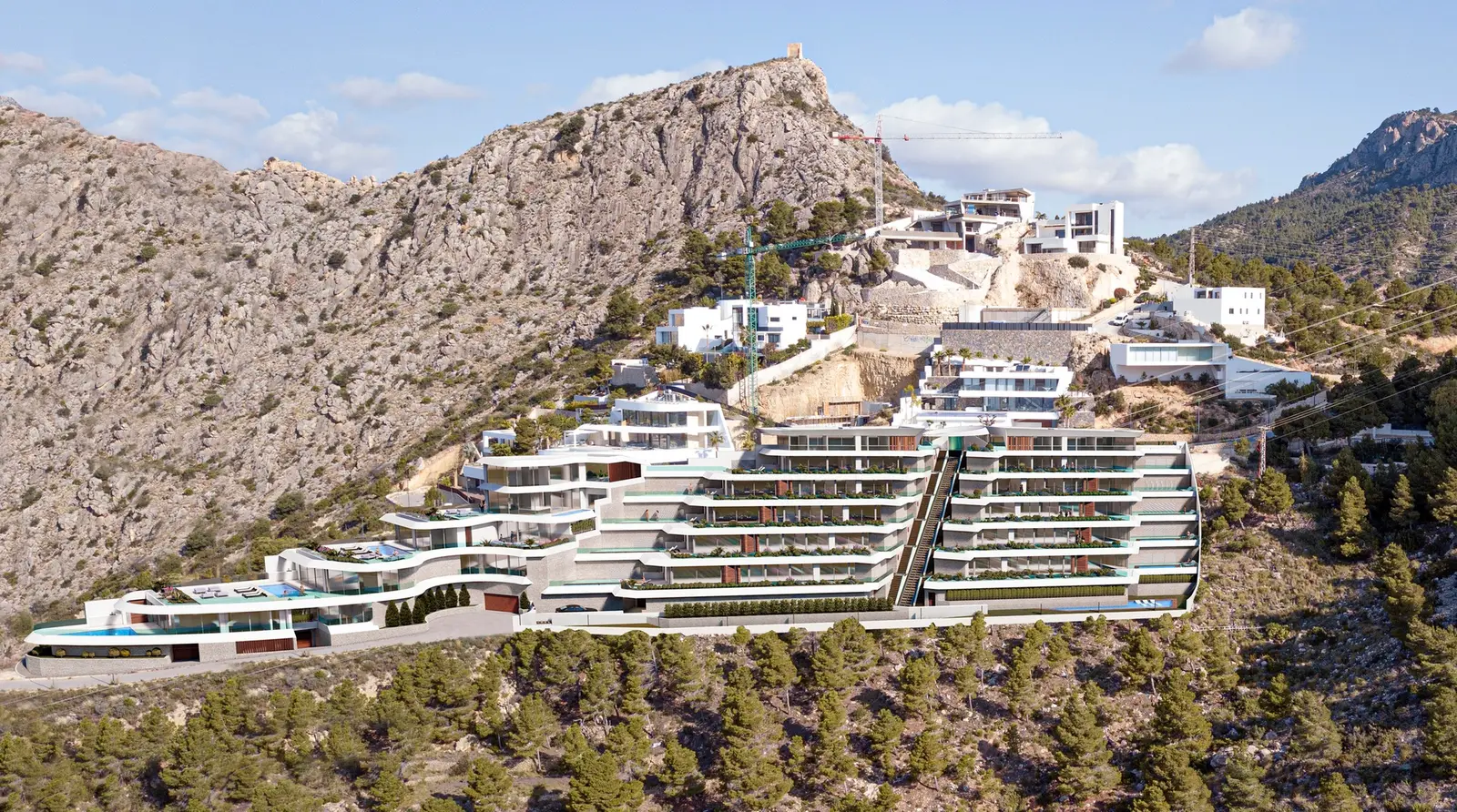
Frequently Asked Questions
What is it like living in Pueblo Mascarat as an expat?
↓
Daily life is quiet and small-scale. The location offers direct sea access and a cliff-side setting above Calpe, with a resident community that skews toward Northern European nationalities. Everyday amenities are in Calpe, two kilometres north. The pace suits buyers who want proximity to a functioning town without living inside one.
How much do properties cost in Pueblo Mascarat?
↓
Based on the projects analysed by veritySpain, asking prices run from €1,200,000 to €2,200,000. This positions Pueblo Mascarat at the premium end of the Costa Blanca market. The price range reflects the cliff-side setting and limited supply of residential units in the urbanisation.
What is the climate like in Pueblo Mascarat?
↓
Alicante province records over 300 days of sunshine per year according to AEMET. Summers reach the mid-30s Celsius; winters rarely fall below 8°C at night. Autumn brings concentrated rainfall. The shoulder months of April to May and September to October offer the most comfortable conditions for new arrivals.
Is there good healthcare near Pueblo Mascarat?
↓
The nearest public health centre is in Calpe, with specialist referral to Hospital Marina Salud in Dénia, around 30 kilometres north. Private clinics in Calpe and Altea offer English-speaking practitioners. Expats who are not EU citizens or who lack reciprocal health rights should plan for private health insurance cover.
Are there international schools near Pueblo Mascarat?
↓
International schooling concentrates in Altea and the La Nucia corridor, roughly 15 kilometres inland. Elian's International School in La Nucia offers a British curriculum. State schools in Calpe enrol expat children and are the main route to language integration for families planning a long-term stay in the area.
What is the expat community like in Pueblo Mascarat?
↓
The resident expat community is established but small, with Dutch, British, German, and Scandinavian nationals the dominant groups. Formal expat associations operate in Calpe and provide practical networks. The setting suits self-sufficient buyers; those looking for a large or active social scene will find more options in Calpe town or Altea.
Do I need a car to live in Pueblo Mascarat?
↓
Yes. Grocery shopping, healthcare, schools, and most services are in Calpe or Altea. Public transport connections along this stretch of the Costa Blanca are limited. Car ownership is a practical necessity for residents, not an optional convenience. Road access from the cliff-side roads into Calpe takes a few minutes by car.