
Living in Punta Prima as an expat: climate, healthcare, schools, costs and community in this Costa Blanca settlement. veritySpain data and practical guidance.
Living in Punta Prima as an expat starts with one practical anchor: veritySpain has reviewed two residential projects here, scoring them an average of 7.8 out of 10, with asking prices ranging from €305,000 to €409,000. That data point matters because it sets expectations honestly. Punta Prima is a small coastal settlement on the southern Costa Blanca, administratively part of Orihuela Costa in the Province of Alicante. It is not a large town with its own civic infrastructure. Most services sit within a short drive in Torrevieja or the broader Orihuela Costa strip. Expats who move here do so for the climate, the seafront, and a pace of life that requires little justification. The questions worth answering are practical: healthcare, schools, costs, and community.
Climate and daily rhythm
Alicante Province averages more than 300 days of sunshine per year, a figure widely cited by Spain's national meteorological agency AEMET, and Punta Prima sits squarely in that band. Summers are long and dry; winters are mild enough for outdoor dining in January. Rain falls mainly between October and December, rarely for more than a day at a stretch. That climate shapes daily life directly. Markets run outdoors year-round. Cycling and walking are viable transport for much of the year. The Mediterranean itself is swimmable from May through October. Residents report structuring their days around the heat: earlier starts, a genuine midday pause, and evenings that extend well past 9 p.m. AEMET climate normals for Alicante province confirm the averages. This is not a dramatic climate claim; it is a consistent, documented pattern that makes outdoor-centred routines sustainable.
Healthcare and essential services
Spain's public health system, the Sistema Nacional de Salud, covers legal residents who are registered on the municipal padrón. Registration in the Orihuela municipality gives access to the public healthcare network, including nearby health centres in Torrevieja and the Hospital de Torrevieja, which is roughly ten minutes by car. That hospital has a full A&E department and specialist units. EU citizens can register directly; non-EU nationals on a Spanish residency visa follow the same padrón route. Private health insurance is a common supplement among the expat population, with several Spanish and international providers operating in the area. Costs are substantially lower than in northern Europe. Pharmacies are well stocked and pharmacists speak enough English to be useful in most situations. Dental care is largely private but affordable by northern European standards.
Schools, families, and the expat community
Several international schools operate within commuting distance of Punta Prima. The Orihuela Costa area has English-language and bilingual options, including schools following the British curriculum, which matters to families relocating from the UK. State schools in the region teach in Spanish and Valencian. For younger children, many expat families use local Spanish schools as an immersive route to language acquisition. Community ties here are largely self-organising. Residents' associations, sports clubs, and informal networks on platforms like Facebook and Nextdoor fill the social infrastructure gap that a small settlement cannot provide through institutions alone. veritySpain data notes that the two analysed projects in Punta Prima are aimed at a buyer profile that skews international, which means the incoming residential base is already weighted toward expat households. That has a compounding effect: English is widely spoken in local bars, estate agents, and service businesses.
Cost of living and financial practicalities
Spain's general cost of living index sits below the EU average, and the Costa Blanca south reinforces that gap. Groceries, restaurants, and utilities cost noticeably less than in Germany, the Netherlands, or the UK. A meal for two at a local restaurant runs well under €40 in most cases. Utility bills for a two-bedroom apartment are modest in spring and autumn; air conditioning in July and August raises electricity costs materially. Tax obligations are important to understand before moving. Spain taxes worldwide income for residents, and the Beckham Law provides a flat-rate option for qualifying new arrivals, though it has eligibility conditions worth reviewing with a gestor. Property transfer tax (ITP) applies to resale purchases; VAT (IVA) applies to new builds. Agencia Tributaria guidance on non-resident and resident taxation covers the framework. A local gestor, rather than a general accountant, is the most efficient first point of contact for navigating Spanish tax registration and annual filings.
Key takeaways
- veritySpain scores Punta Prima projects at 7.8/10, with asking prices between €305,000 and €409,000.
- AEMET records more than 300 sunshine days annually in Alicante Province, shaping a year-round outdoor lifestyle.
- Public healthcare is accessible via padrón registration; the Hospital de Torrevieja is approximately ten minutes away.
- International and bilingual schools within commuting distance serve families relocating from northern Europe.
- A local gestor is essential for navigating ITP, IVA, and Spanish resident tax obligations efficiently.
The market in numbers
New-build projects in Punta Prima
View all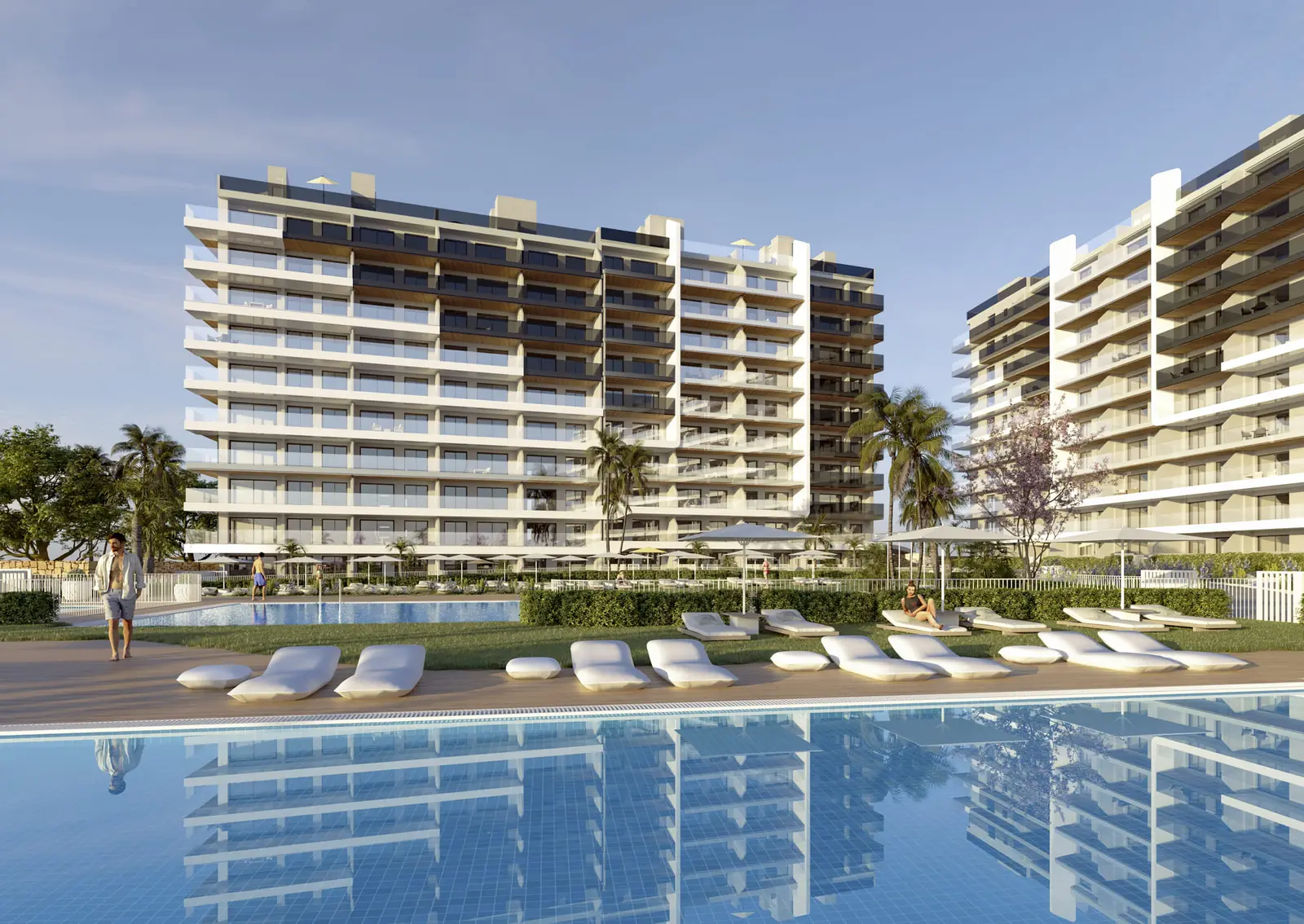
Frequently Asked Questions
Is Punta Prima a good place for expats to live?
↓
Punta Prima suits expats who prioritise a coastal climate and a calm pace of life over urban amenities. It is a small settlement within the Orihuela Costa strip, so daily services require short drives. veritySpain scores the analysed projects at 7.8 out of 10, reflecting a manageable entry point for the southern Costa Blanca.
What is the cost of housing in Punta Prima?
↓
Asking prices on the two projects veritySpain has reviewed range from €305,000 to €409,000. These are new-build or recently marketed properties. Resale stock varies, and buyers should budget for ITP (property transfer tax) on resale or IVA on new builds on top of the purchase price.
How does the Spanish healthcare system work for expats in Punta Prima?
↓
Legal residents registered on the Orihuela municipal padrón gain access to Spain's public health system. The nearest major facility is the Hospital de Torrevieja, about ten minutes by car. Many expats also carry private health insurance as a supplement, which is widely available and affordable compared to northern European equivalents.
Are there English-language schools near Punta Prima?
↓
Yes. The Orihuela Costa area has several international and bilingual schools within reasonable driving distance, including schools following the British curriculum. State schools teach in Spanish and Valencian. Many expat families use local schools for language immersion while supplementing with extracurricular English-language activities.
What is the climate like in Punta Prima year-round?
↓
Punta Prima falls within Alicante Province, where AEMET records more than 300 sunshine days per year. Summers are hot and dry; winters are mild. Rainfall concentrates in October to December. The sea is swimmable from May through October. Most outdoor activities are viable throughout the year.
What taxes do expats pay when buying property in Punta Prima?
↓
New-build purchases are subject to IVA (VAT) and stamp duty. Resale purchases attract ITP, the property transfer tax. Once resident, Spain taxes worldwide income. The Beckham Law flat-rate regime applies to some new arrivals under specific conditions. A local gestor is the most practical way to navigate the Spanish tax registration process.
Is there an established expat community in Punta Prima?
↓
Punta Prima is a small area, but it sits within the broader Orihuela Costa expat belt. Community ties form through residents' associations, sports clubs, and informal social networks. English is widely spoken in local businesses. The buyer profile for new projects in the area skews international, so the resident base already has a significant expat component.