Living in Jimenado as an expat: climate, cost of living, healthcare, schools and community in this small Murcia village. veritySpain's independent guide.
Living in Jimenado as an expat means settling in a small Murcia village where veritySpain has tracked one residential project priced at €260,000 and awarded it a score of 7.0/10. That single data point tells a clear story: this is a quiet corner of Costa Cálida, not a resort strip. The village sits inland from the Mar Menor and about 30 kilometres south of Murcia city, which means residents trade beachfront noise for genuine neighbourhood calm. Infrastructure is modest, but the fundamentals that matter to long-term residents, including road links, local services, and access to the wider Murcia health system, are in place. For expats who prioritise low-density living over coastal spectacle, Jimenado warrants serious consideration.
Climate and everyday outdoor life
Murcia records more than 300 days of sunshine per year, a figure cited consistently by the Spanish Meteorological Agency (AEMET), and Jimenado sits squarely within that climatic zone. Winters are mild: daytime temperatures rarely fall below 10°C, and frost is uncommon at the village's elevation. Summers are long and dry, with July and August regularly reaching the mid-thirties. A practical consequence: heating bills stay low. Air-conditioning is standard in modern builds, and the project veritySpain tracked at €260,000 is a new-build, so thermal performance is governed by current Spanish building code CTE-HE. Outdoor activity is year-round. The Sierra Minera hills to the east offer walking trails. The Mar Menor lagoon, roughly 25 kilometres away, is the nearest large body of water for swimming. Cyclists use the regional network of secondary roads that connect Murcia's inland villages. The pace of life outside is unhurried.
Cost of living and housing context
One verified price point exists for Jimenado: €260,000 for a new residential property, as recorded in veritySpain's feed. Beyond that single figure, broader cost-of-living data comes from national and regional sources rather than local transaction volumes. INE (Instituto Nacional de Estadística) tracks consumer price indices at regional level, and Murcia consistently ranks among Spain's more affordable regions. Groceries, restaurant meals, and utility costs in Murcia province run noticeably below Madrid or Barcelona benchmarks. Property transfer tax (ITP) in the Murcia region is applied at established rates set by the regional government; buyers should confirm the current rate with a licensed Spanish notary. For expats comparing Jimenado with coastal alternatives in the same province, the trade-off is straightforward: lower ambient prices, lower tourist-season crowds, and a housing stock that is thin but not non-existent. Rental supply in a village this size is limited, so most long-term expat residents buy.
Healthcare and schools
Spain's public health system, the Sistema Nacional de Salud, covers registered residents including EU nationals and non-EU expats who contribute to social security. Ministerio de Sanidad, España publishes the coverage framework. The nearest primary care centre (centro de salud) serving Jimenado is in the Torre-Pacheco municipality, roughly 10 kilometres away, with Hospital Los Arcos del Mar Menor in San Javier as the main secondary-care facility for the southern Murcia coast. Emergency response times in rural Murcia are longer than in urban centres; private health insurance is worth considering for residents who want faster specialist access. On education: Jimenado itself has no international school. The nearest English-language or bilingual private schools operate in Murcia city and along the coast near Los Alcázares. Families with school-age children typically drive or arrange transport. State schools in Torre-Pacheco follow the Murcia regional curriculum and are Spanish-medium.
Expat communities and social integration
Jimenado has a small, established community of Northern European residents, particularly British and German nationals, drawn by the rural character and affordable entry prices relative to coastal Spain. Formal expat associations are based in larger nearby towns rather than the village itself, but informal networks, including social media groups for Costa Cálida and Murcia expats, are active and practically useful for new arrivals. Spanish is the working language of daily life; English is spoken in some shops near the coast but is not routine in Jimenado's village services. Integration is smoother for residents who invest in basic conversational Spanish. Local fiestas follow the Murcia calendar, with patron-saint celebrations providing the main community gathering points each year. The social texture is small-town Mediterranean: neighbours know each other, commercial activity is limited, and the nearest significant retail and dining options are in Torre-Pacheco or the coastal strip near Cabo de Palos.
Key takeaways
- veritySpain rates Jimenado's one tracked project at 7.0/10, with entry pricing at €260,000 for new build.
- Murcia's 300-plus sunshine days per year make year-round outdoor living realistic; winters are mild and dry.
- Public healthcare is available via the national system, with the nearest hospital in San Javier, roughly 20 kilometres away.
- No international schools operate in Jimenado; families rely on bilingual private schools in Murcia city or the coast.
- Integration requires functional Spanish; expat social networks centre on nearby towns rather than the village itself.
The market in numbers
New-build projects in Jimenado
View all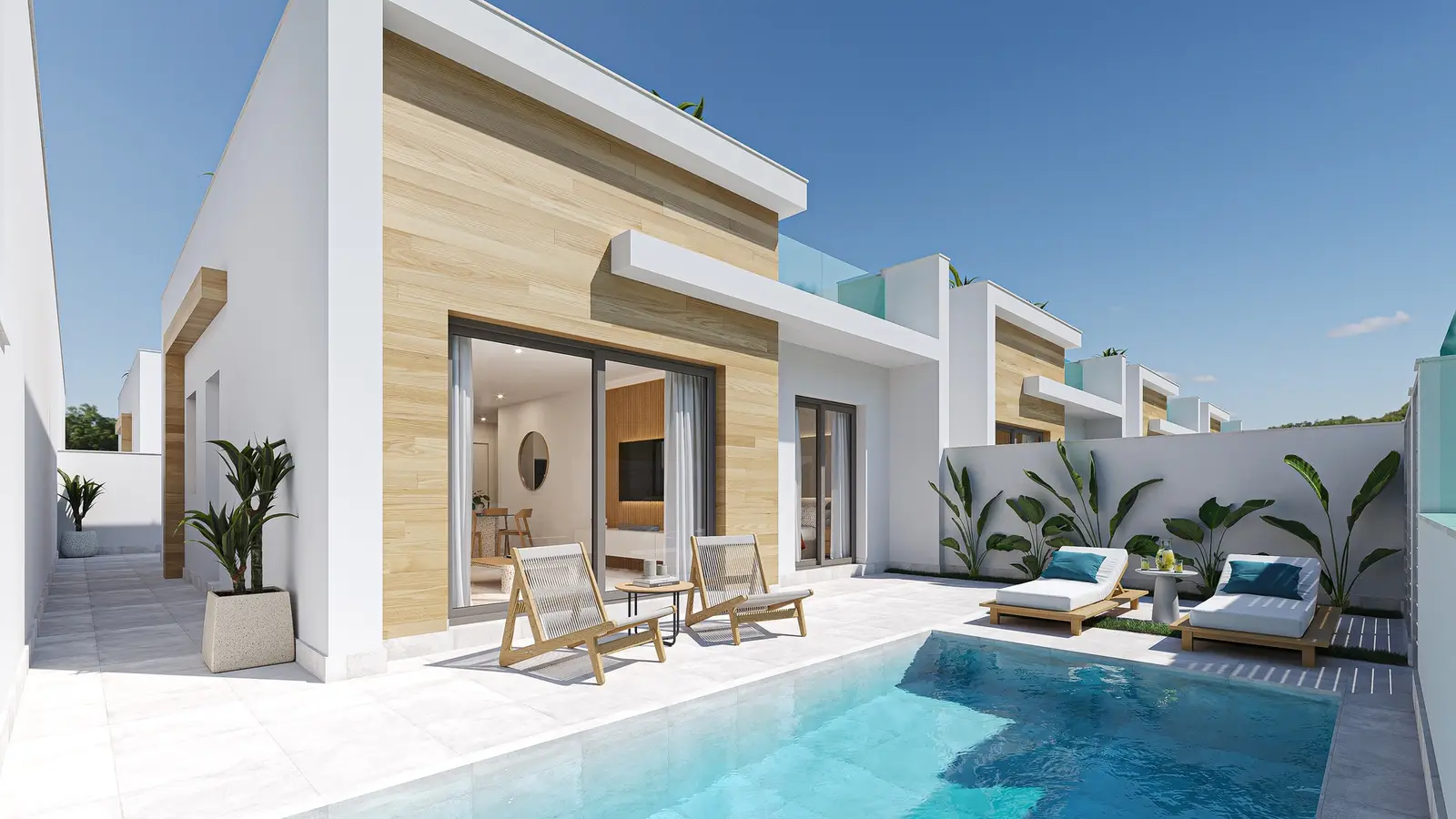
Frequently Asked Questions
Is Jimenado a good place to live as an expat?
↓
Jimenado suits expats who want rural calm rather than coastal bustle. The village offers low-density living in Murcia's sunny climate, with access to the Mar Menor and Murcia city within 30 kilometres. Services are limited, so residents depend on Torre-Pacheco and nearby towns for shopping, healthcare, and schools. It rewards those who value quiet over convenience.
What is the cost of living in Jimenado compared to coastal Spain?
↓
Murcia province is one of Spain's more affordable regions according to INE data. Jimenado sits inland, so everyday costs for groceries, utilities, and restaurants run below coastal resort towns. The one verified property price in veritySpain's data is €260,000 for a new-build. Rental availability is thin; most long-term residents purchase rather than rent.
What healthcare is available near Jimenado?
↓
Registered residents access Spain's public health system. The nearest primary care centre is in Torre-Pacheco, about 10 kilometres away. Hospital Los Arcos del Mar Menor in San Javier handles secondary and emergency care. Response times in rural areas can be slower than in cities, so many expats supplement public cover with private health insurance for faster specialist access.
Are there international or English-medium schools near Jimenado?
↓
Jimenado has no international school. The nearest English-language and bilingual private schools are in Murcia city and along the coast near Los Alcázares. State schools in Torre-Pacheco follow the Murcia regional curriculum and teach in Spanish. Families with school-age children typically arrange daily transport to schools in larger nearby towns.
What is the climate like in Jimenado, Murcia?
↓
Jimenado shares Murcia's climate: more than 300 sunshine days per year as recorded by AEMET, mild winters with daytime temperatures rarely below 10°C, and long dry summers reaching the mid-thirties in July and August. Frost is uncommon. The dry, warm conditions make outdoor activity practical throughout the year, including cycling on regional roads and walking in the Sierra Minera hills.
Is there a community of expats in Jimenado?
↓
A small, established community of Northern European expats, notably British and German nationals, lives in and around Jimenado. Formal associations are based in larger towns nearby. Active online groups cover Costa Cálida and Murcia broadly and are a practical resource for new arrivals. Daily village life operates in Spanish, so basic language skills significantly ease social integration.
How far is Jimenado from the coast and Murcia city?
↓
Jimenado is approximately 25 kilometres from the Mar Menor lagoon and the nearest beach areas on the Costa Cálida. Murcia city lies around 30 kilometres to the north, accessible via the A-30 and regional roads. The regional airport at Murcia International (Corvera) is roughly 20 kilometres away, making international travel convenient for residents.