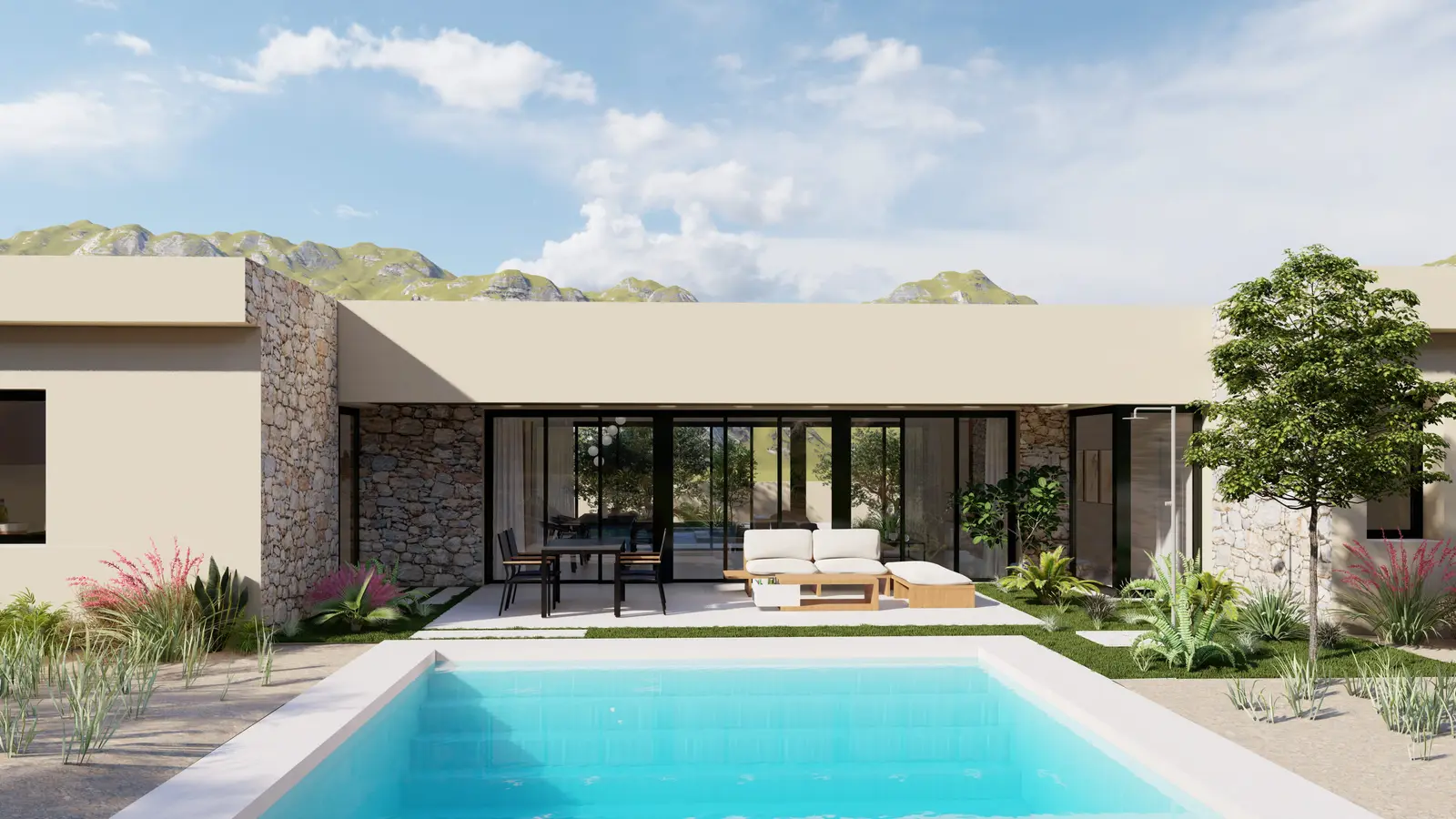
Living in Yecla as an expat means joining a real Murcian town at 700 m altitude. veritySpain scores it 6.9/10. Climate, costs, healthcare and schools explained.
Living in Yecla as an expat means choosing a municipality where veritySpain has tracked one project to date, priced at €774,000, and awarded an editorial score of 6.9 out of 10. That score reflects honest potential balanced against limited market depth. Yecla sits inland in the Murcia region, roughly 90 kilometres north of the regional capital, at an altitude of around 700 metres. The elevation gives it a continental climate: dry, hot summers, cold winters, and more than 300 sunny days per year. It is a working town of approximately 34,000 people, best known historically for furniture manufacturing and wine production under its own Denominación de Origen. Expats who settle here tend to be looking for precisely that: a real Spanish town, not a coastal resort.
Climate and daily environment
Yecla records summer highs regularly above 38°C and winter overnight lows that can fall below freezing. Spain's national meteorological agency, AEMET, classifies the area as a semi-arid continental climate (BSk in Köppen terms). That is the practical baseline. Summers are long and genuinely hot; air conditioning is not optional. Winter requires central heating or wood stoves, both common in local housing stock. Spring and autumn are the most comfortable seasons, with mild temperatures and little rain. The town sits on a wide agricultural plain, so there is no sea breeze moderation. Dust from surrounding fields can be noticeable in dry periods. For expats from northern Europe, the heat demands adjustment. The upside: outdoor life is viable for roughly eight months of the year, and the light quality is exceptional.
Cost of living and healthcare
Yecla is materially cheaper to live in than any comparable coastal town in Murcia or the Valencia region. Weekly groceries in local supermarkets (Mercadona, Lidl) run at roughly Spanish national averages, which INE (Instituto Nacional de Estadística) tracks as significantly below the EU-27 median. Restaurant meals at local bars cost between €10 and €15 for a full menu del día including wine. Housing costs the most significant divergence: rental stock is limited, but monthly rents for a three-bedroom apartment in the town centre are typically well below Murcia city or Cartagena levels. Healthcare access is through the Centro de Salud system under the Servicio Murciano de Salud. EU citizens with an EHIC or S1 form can register with a GP. The nearest full hospital is the Hospital Virgen del Castillo in Yecla itself, which handles general and emergency care. Specialist treatment beyond that level routes to Albacete or Murcia capital.
Schools, communities, and language
Yecla has no international school. Spanish state schools operate in the town, with instruction in Castilian Spanish; Valencian is not spoken here as Murcia is a Castilian-only region. Children of expat families typically integrate into local state schools, which can work well but requires a commitment to Spanish-language immersion from an early age. Secondary education is available locally. The town has no significant British, German or Dutch expat community comparable to coastal areas. That is a factual constraint worth stating plainly. There are isolated expat residents, some in rural fincas on the outskirts, but no clubs, no English-language services and no critical mass of foreign-language social infrastructure. Expats who thrive here tend to speak Spanish, or commit seriously to learning it. The town is sociable and not unwelcoming to foreigners, but social life runs entirely through Spanish channels.
Buying property in Yecla
VeritySpain's feed shows one active new-build project in Yecla at €774,000, which positions it toward the upper end of Murcia inland pricing. Transaction volumes for the municipality are modest. The Registradores de España publish regional data on property transfers, and Murcia's inland zones consistently show lower turnover than coastal areas, which has implications for resale liquidity. Buyers should factor in standard acquisition costs: ITP (Impuesto de Transmisiones Patrimoniales) for resale properties in Murcia is 8%, with IVA at 10% for new builds. Notary, registry and legal fees add approximately 1.5–2% on top. Foreign buyers need an NIE (Número de Identificación de Extranjero) before completing. Given the thin market, independent legal advice from a local gestor or abogado is not optional. Yecla offers space, quiet and an authentic setting. The trade-off is illiquidity and limited services compared with the coast.
Key takeaways
- VeritySpain scores Yecla 6.9/10 with one tracked project at €774,000, reflecting emerging rather than established demand.
- The continental climate delivers 300-plus sunny days but also serious summer heat and cold winters requiring prepared housing.
- Healthcare is available locally through the state system; specialist care routes to Murcia or Albacete.
- No international school or established expat community exists, so Spanish-language confidence is a practical requirement.
- Property acquisition costs in Murcia (ITP 8% or IVA 10% for new builds) and low resale liquidity should be modelled before committing.
The market in numbers
New-build projects in Yecla
View allFrequently Asked Questions
Is Yecla a good place for expats to live?
↓
Yecla suits expats who want authentic Spanish town life rather than a resort setting. It scores 6.9/10 in veritySpain's editorial assessment. The town has good local services, a genuine community and low costs, but no international school, no established expat network and a thin property resale market. Spanish-language ability is a practical necessity.
What is the cost of living in Yecla compared to the coast?
↓
Day-to-day costs in Yecla are lower than comparable coastal towns in Murcia or the Valencia region. Groceries track at Spanish national averages, restaurant menus del día run at €10–€15, and rents are below Murcia city levels. Property prices are modest by coastal standards, though veritySpain's one tracked new-build project is priced at €774,000.
What is the climate like in Yecla?
↓
Yecla has a semi-arid continental climate at roughly 700 metres altitude. Summers are hot, regularly above 38°C, and winters are cold with occasional frosts. AEMET classifies it as Köppen BSk. The town records more than 300 sunny days per year. Spring and autumn are the most comfortable seasons for outdoor activity.
Is there an international school in Yecla?
↓
No. Yecla has no international school. Local state schools teach in Castilian Spanish. Expat children typically integrate into the Spanish state system, which requires strong commitment to language immersion. Secondary education is available locally. Families requiring English-medium or bilingual schooling need to travel to Murcia capital or Alicante.
How does healthcare work for expats in Yecla?
↓
Healthcare is provided through the Servicio Murciano de Salud. EU citizens with a valid EHIC or S1 form can register with a local GP at the Centro de Salud. Yecla has its own hospital, the Hospital Virgen del Castillo, for general and emergency care. Specialist treatment beyond that level routes to Murcia city or Albacete.
What are the property purchase costs in Murcia region?
↓
Buying a resale property in Murcia incurs ITP at 8% of the purchase price. New-build properties are subject to IVA at 10% plus stamp duty (AJD). Notary, land registry and legal fees add approximately 1.5–2%. Foreign buyers must obtain an NIE before completion. Independent legal advice from a local abogado or gestor is strongly advisable.
How does Yecla's property market compare to coastal Murcia?
↓
Yecla's inland market is thinner than coastal areas like Cartagena or Mazarrón. Transaction volumes are modest, as Registradores de España data for Murcia inland zones consistently shows. VeritySpain tracks one project at €774,000. Resale liquidity is lower than the coast, which is a material consideration for buyers planning an eventual exit.