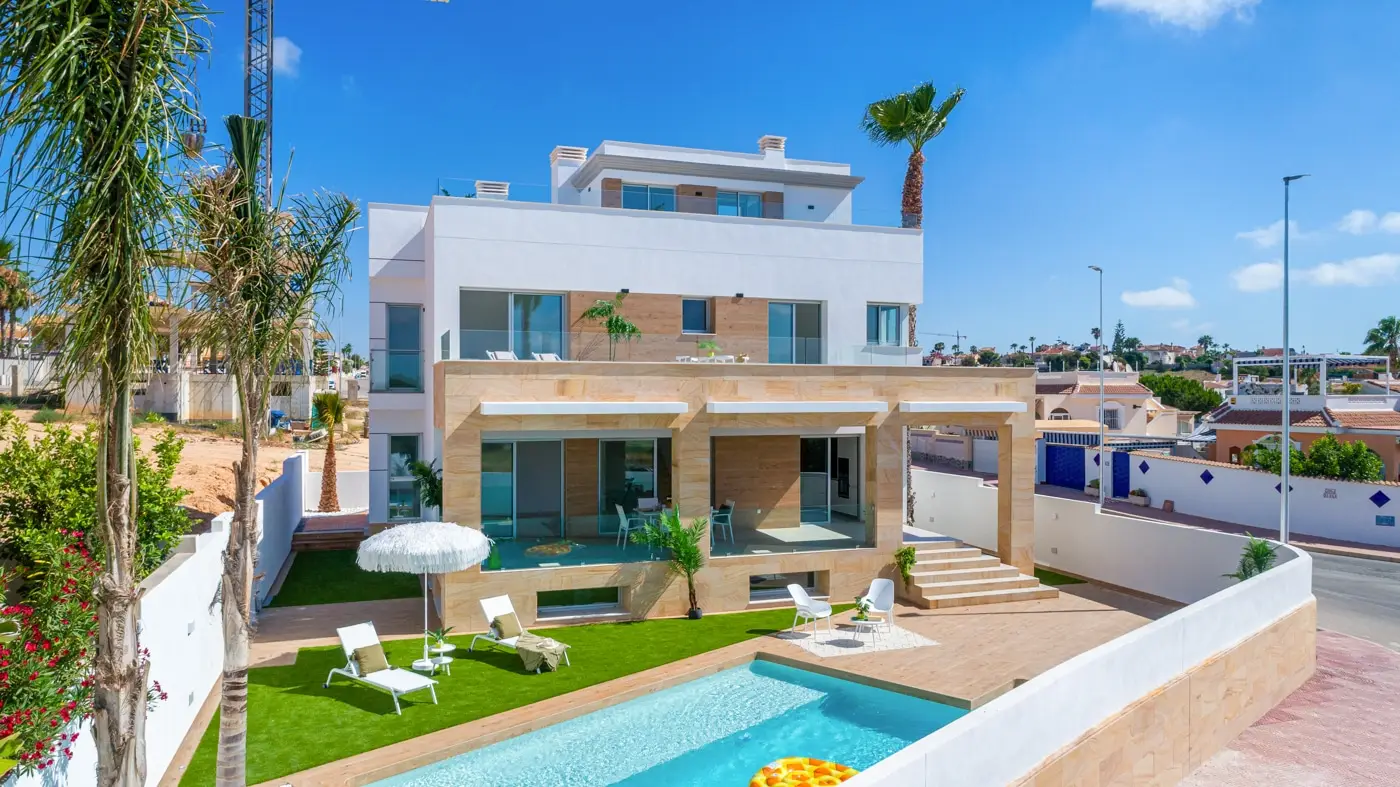
New build ciudad quesada properties range €314k–€1,590k. Step-by-step guide to NIE, contracts, bank guarantees, taxes and completion costs for international buyers.
New build ciudad quesada properties span a price range of €314,000 to €1,590,000 across 23 projects currently tracked by veritySpain, which assigns the area an average score of 7.3 out of 10. That spread reflects a market serving both budget-conscious buyers entering at the lower tier and purchasers seeking larger, more specified homes further up the range. Ciudad Quesada sits inland from Torrevieja in the province of Alicante, part of the Costa Blanca South. The buying process for an off-plan or newly completed property in Spain follows a well-defined legal sequence. Understanding each stage before you sign anything saves time, avoids surprises on completion, and protects your deposit from day one.
Reservation and NIE: the first two steps
Signing a reservation contract secures the specific unit and fixes the agreed price. Fees are modest, typically in the low thousands of euros, and are deducted from the final purchase price. Immediate priority: apply for a Número de Identificación de Extranjero (NIE), the tax identity number every non-Spanish buyer must hold before a notary will complete a title deed. The NIE can be obtained at a Spanish consulate in your home country or at a Policía Nacional station with the correct appointment. Allow at least two to four weeks if applying abroad. Open a Spanish bank account at the same time. You cannot pay the developer's stage payments or the final balance from a foreign account with any practical reliability. Colegio de Registradores de España processing records confirm that deeds signed without a valid NIE are invalid.
Private purchase contract and deposit protection
After reservation, the developer issues a Contrato de Arras Penitenciales or a full private purchase contract. Ten percent of the purchase price is the conventional deposit level at this stage, though amounts vary by developer. Spanish law, specifically the 1968 Ley de Percepción de Cantidades Anticipadas updated by Ley 20/2015, requires all stage payments made before completion to be held in a guaranteed bank account or covered by an insurance policy, with a bank guarantee (aval bancario) issued to the buyer on request. Never pay a stage payment without first receiving the corresponding aval. This guarantee means that if the developer fails to deliver on time or at all, you can reclaim your money. The developer must also hold a valid licence of first occupation (licencia de primera ocupación) for the finished property before you complete. Ministerio de Vivienda y Agenda Urbana (Spain) guidance sets out these consumer protections in detail.
Notary completion and transfer costs
Completion takes place before a Spanish notary, who reads the entire deed aloud, confirms the parties' identities and the property details, and witnesses signatures. Budget for purchase costs on top of the agreed price. New build properties in the Valencian Community attract IVA (VAT) at 10%, plus Actos Jurídicos Documentados (AJD), the stamp duty, which is set by each autonomous community. Notary fees and land registry fees are modest by comparison. Total acquisition costs for a new build in this region typically settle in the range of 12% to 14% on top of the purchase price, though exact figures depend on the property value and the specific financing structure. Arrange a currency transfer early if purchasing in sterling or another non-euro currency, because exchange rate moves over an 18-month construction period can significantly alter the effective price you pay.
Mortgage and post-completion obligations
Arranging a Spanish mortgage is possible for non-residents, though loan-to-value ratios for non-residents are generally lower than for Spanish residents, and some lenders require that the buyer already holds a Spanish bank account with a track record. Spanish banks must provide a Ficha de Información Precontractual (FIPRE) and a Ficha de Información Personalizada (FIPER) before any mortgage agreement is signed, obligations introduced by the 2019 mortgage law. After completion, connect utilities in your name (water, electricity), register the property with the local Catastro for council tax (IBI) purposes, and file the annual Modelo 210 non-resident income tax return even if the property is not rented out. The municipality of Rojales, which administers Ciudad Quesada, maintains local registration requirements that your solicitor can guide you through. Transaction volumes in the Alicante province have held up notably well compared to other Spanish coastal provinces, as noted in periodic reporting by Registradores de España, though specific current-year figures should be verified directly from their published quarterly data.
Key takeaways
- The 23 veritySpain-tracked projects in Ciudad Quesada range from €314,000 to €1,590,000 with an average score of 7.3.
- Obtain your NIE before or immediately after signing a reservation; no Spanish deed is valid without one.
- Every stage payment on an off-plan purchase must be covered by a bank guarantee (aval bancario) under Spanish consumer law.
- New builds in the Valencian Community attract 10% IVA plus AJD stamp duty; total acquisition costs run roughly 12–14% extra.
- Post-completion, register utilities, file annual non-resident tax returns, and confirm local Catastro registration with your solicitor.
The market in numbers
New-build projects in Ciudad Quesada
View all
Frequently Asked Questions
What taxes do I pay when buying a new build in Ciudad Quesada?
↓
New build properties in the Valencian Community attract IVA (VAT) at 10% of the purchase price, plus Actos Jurídicos Documentados (AJD) stamp duty set by the regional government. Notary and land registry fees add a smaller amount. Total acquisition costs typically fall between 12% and 14% on top of the agreed purchase price, depending on property value and financing.
Do I need a Spanish bank account to buy a new build in Ciudad Quesada?
↓
Yes, in practice you need a Spanish bank account. Developers require stage payments and the final completion balance to be transferred from a Spanish account. It also simplifies setting up direct debits for utilities and IBI council tax after completion. Open the account early in the process, at the same time as applying for your NIE.
How long does the buying process take in Ciudad Quesada?
↓
The timeline depends on whether you are buying off-plan or a completed new build. Off-plan purchases typically involve an 18-to-24-month construction period between private contract and notary completion. Buying a finished unit shortens the process considerably; completion can occur within weeks of signing the private contract, once financing and legal checks are finalised.
Is my deposit protected if the developer fails to complete in Ciudad Quesada?
↓
Yes, Spanish law requires developers to protect all stage payments through a bank guarantee (aval bancario) or insurance policy. If the developer fails to deliver the property by the agreed date, you are entitled to recover your full deposit plus statutory interest. Always request the written aval before transferring any stage payment; without it, recovery becomes legally complex.
What is the NIE and why do I need it to buy property in Spain?
↓
The NIE (Número de Identificación de Extranjero) is the tax identification number issued to non-Spanish nationals. Spanish law requires every buyer to hold a valid NIE before a notary can sign off a title deed. Without it, the transaction cannot be registered in the land registry. Apply at a Spanish consulate abroad or at a Spanish police station, allowing several weeks for processing.
What is the average price of new build properties in Ciudad Quesada?
↓
According to veritySpain data, the 23 tracked new-build projects in Ciudad Quesada range from €314,000 to €1,084,000. The range reflects different property sizes, specifications, and locations within the municipality. The veritySpain average project score for the area is 7.3 out of 10, indicating generally solid build quality and location fundamentals across the tracked developments.
Do I need a Spanish solicitor to buy a new build in Ciudad Quesada?
↓
Hiring an independent Spanish solicitor (abogado) is not legally required but is strongly advisable for international buyers. A solicitor checks the title, verifies planning permissions, confirms the bank guarantee is in place, reviews the private purchase contract, and attends the notary on your behalf if needed. Their fee is a modest cost relative to the protection they provide on a purchase of this size.